近日,我校水产学院设施渔业何绪刚/侯杰团队在微生物生态学国际期刊 Microbiome 上发表题为“Intestinal ROS triggers stress-induced dysbiosis by dismantling the hypoxic barrier”的研究论文。该研究以斑马鱼和小鼠为模型,提示了应激性菌群失调发生之前一个此前较少被关注的早期环节。研究将应激性菌群失调从群落结构改变重新定位为早期功能与微环境崩溃,为应激相关肠道微生态紊乱的干预提供了新的上游靶点。
应激与肠道菌群失调间的关联已在人类、啮齿类、非人灵长类和鱼类中反复被观察到,如水产养殖中常见的高密度拥挤、温度剧变和氨氮升高等鱼类常见慢性应激源诱导的菌群失调,但这种关联的跨物种一致性长期缺乏机制解释。核心困难在于:应激是非感染性的,且在早期并不伴随明显的肠道结构损伤,那么它如何通过宿主—微生物之间相对稳定的代谢互作,触发可重复的菌群重塑?过去的研究多聚焦于应激后菌群组成的改变,对群落结构改变前的过程关注不足。
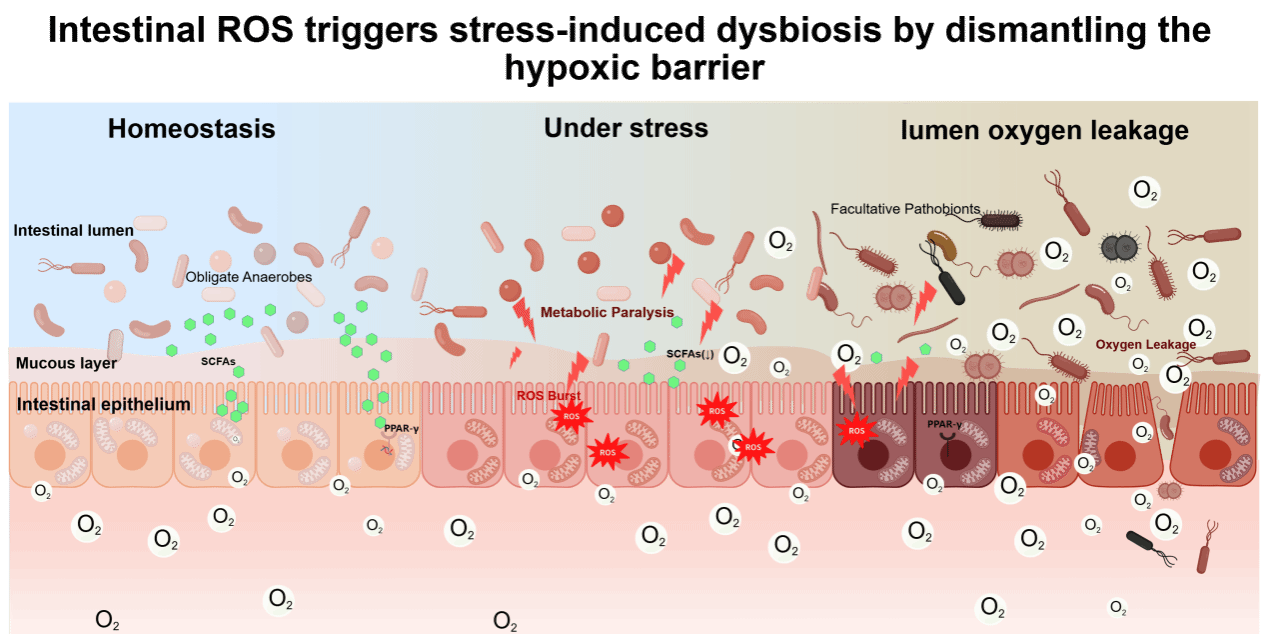
应激诱导肠道菌群失调的机制示意图
应激迅速诱发肠道ROS,且先于菌群结构改变
研究团队在斑马鱼中建立了拥挤、变温和氨氮胁迫三种应激模型,尽管应激源性质不同,但肠道菌群均收敛于一个可重复的失调状态:专性厌氧菌急剧耗竭,兼性/耐氧类群扩张。生态学分析进一步表明,这种收敛并非随机漂变,而是确定性选择过程增强的结果。那么,选择压力来自哪里?时间序列分析发现:应激后肠道ROS即快速积累;而菌群结构的明显分离和关键厌氧菌的下降则更晚出现,即在组成失调可识别前,肠道已发生快速的氧化还原状态转变。
ROS首先抑制发酵功能,而非直接杀死细菌
应激早期,肠道微生物关键代谢物短链脂肪酸(SCFAs)在2天内下降超过30%,但16S rRNA基因绝对定量显示总细菌载量并未同步下降。换言之,菌群仍在,但发酵受到抑制。在体外严格厌氧条件下培养关键厌氧菌Cetobacterium somerae,亚致死浓度的H2O2使SCFAs产量下降幅度远超细菌活力降低幅度,证明ROS优先抑制代谢、而非直接清除厌氧菌。
SCFAs短缺削弱上皮呼吸,缺氧屏障随之瓦解
SCFAs是肠道上皮线粒体呼吸的重要燃料。应激早期SCFAs下降后,PPARγ依赖的上皮线粒体程序(pparg、ppargc1a、angptl4及多个电子传递链组分)受到抑制,上皮ATP含量和丙酮酸脱氢酶活性下降,氧消耗能力减弱,缺氧屏障随之受损。抗生素加速SCFAs耗竭将缺氧丧失提前,而SCFAs补充、抗氧化干预或PPARγ激动剂5-ASA则能推迟或阻止缺氧屏障的崩溃。
在小鼠束缚应激模型中,观察到了高度一致的轨迹:结肠ROS升高、粪便SCFAs下降、缺氧信号减弱,以及随后的兼性肠杆菌科扩张、专性厌氧菌减少。这一跨脊椎动物的表型收敛提示,肠道ROS介导的缺氧屏障失稳可能是进化上保守的。在应用层面,该研究提示,靶向肠道ROS或恢复上皮生物能量学,可能成为更具上游意义的干预策略;对于水产养殖中高养殖密度、温度剧变、氨氮胁迫等常见生产场景下的肠道健康管理,这一思路也具有直接的转化潜力。
华中农业大学水产学院已毕业博士研究生吕亚兵(现中国海洋大学博士后)为论文第一作者,何绪刚教授、侯杰副教授和中国农业科学院饲料研究所周志刚研究员为共同通讯作者。该研究得到了国家重点研发计划、国家自然科学基金、国家现代农业产业技术体系等项目的资助。
【英文摘要】
Background Stress consistently disrupts the vertebrate gut microbiome, leading to negative health outcomes. However, how systemic stress translates into reproducible microbial dysbiosis remains poorly understood. While current research primarily focuses on late-stage compositional shifts, the early biochemical signals and micro environmental alterations that precede and initiate this structural breakdown represent a critical knowledge gap.
Results Here we show that stress destabilizes the gut microbiome through a cascade initiated by intestinal reactive oxygen species (ROS). In zebrafish, stress rapidly elicits intestinal ROS accumulation in the distal intestine, emerging within hours and preceding any detectable changes in microbial composition. This early oxidative response does not immediately restructure the community but instead induces a functional collapse: anaerobic fermentation is selectively suppressed and short-chain fatty acids (SCFAs) production sharply declines while community structure remains largely intact. The resulting SCFAs deficit weakens PPARγ-dependent epithelial metabolic programs, diminishes epithelial oxygen consumption, and erodes the physiological hypoxic barrier. Loss of this barrier re-engineers the luminal niche, enabling the relative enrichment of facultative pathobionts. Restoring epithelial bioenergetics or neutralizing intestinal ROS in zebrafish preserves hypoxia and prevents dysbiosis despite continued stress, identifying intestinal ROS as an early initiating signal of stress-induced dysbiosis. In restraint-stressed mice, the same ordered sequence—early ROS elevation, SCFAs decline, hypoxia loss, and the relative enrichment of facultative taxa—is likewise observed, supporting phenotypic and temporal conservation of this cascade.
Conclusions Our findings reveal that stress-induced dysbiosis is not a stochastic microbial drift, but a highly reproducible ecological cascade that is triggered by an early intestinal ROS burst in zebrafish and phenotypically conserved in mice. By shifting the paradigm from late-stage structural dysbiosis to the initial functional and microenvironmental collapse, we identify the maintenance of the intestinal hypoxic barrier as a critical therapeutic target for stress-related microbiome disorder.
论文链接:https://link.springer.com/article/10.1186/s40168-026-02567-7

